Food waste remains one of the most pressing global challenges in modern agriculture. According to international estimates, a significant percentage of fresh produce never reaches the final consumer in optimal condition. In perishable categories such as vegetables, supply chain inefficiencies directly reduce farmer income and increase operational losses.
A structured and intelligence-driven fresh vegetable supply chain can significantly reduce waste while improving price stability and income predictability for farmers.
Why Fresh Vegetables Face Higher Waste Risk
Unlike grains or packaged goods, fresh vegetables are biologically active. After harvest, respiration continues, moisture loss begins, and environmental exposure accelerates degradation. Delayed transportation, improper storage, and demand mismatch increase spoilage rates.
Reducing waste therefore requires operational precision from farm to wholesale market and finally to retailers or institutional buyers.
Predictive Demand Planning
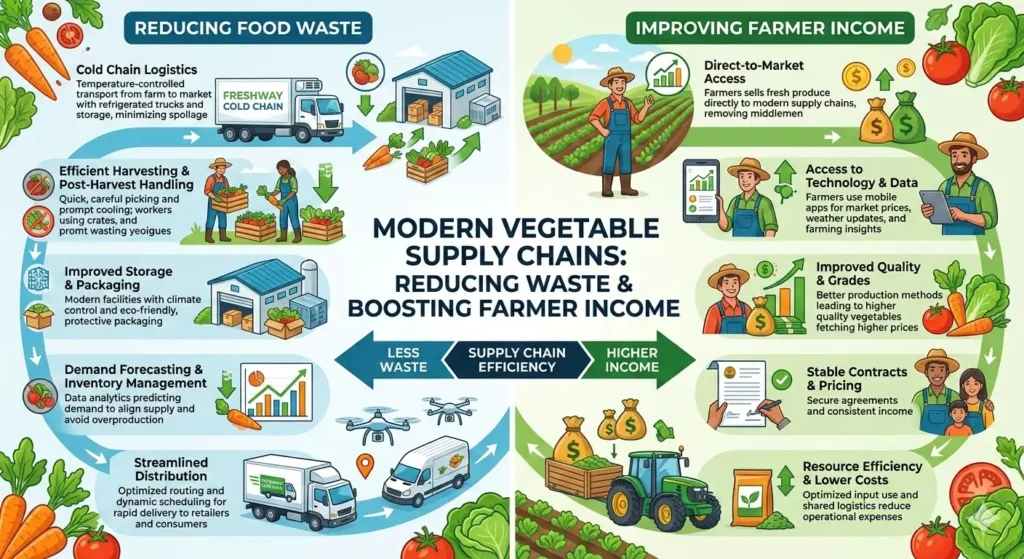
One of the most effective methods to reduce vegetable waste is demand forecasting. By analyzing seasonal consumption patterns, historical order volumes, and regional buying behavior, suppliers can align procurement with actual demand.
Accurate forecasting minimizes over-harvesting and prevents market oversupply situations that often lead to price crashes for farmers.
Efficient Logistics and Handling Systems
Structured route planning, early dispatch cycles, protective packaging, and controlled handling significantly extend vegetable shelf life. Even small improvements in transit time can reduce spoilage percentages across scale.
Precision logistics strengthens both quality consistency and profit margins for commercial buyers.
Impact on Farmer Income Stability
When waste is reduced, more produce reaches the market in sellable condition. This increases effective supply utilization and reduces distress selling. Structured procurement agreements further protect farmers from unpredictable price drops.
Stable demand signals and disciplined sourcing systems improve income predictability, allowing farmers to plan crop cycles with greater confidence.
Global Perspective on Food Waste Reduction
The Food and Agriculture Organization of the United Nations (FAO) emphasizes that improving supply chain efficiency is one of the most effective strategies to reduce post-harvest losses in developing and emerging markets.
Integrating agricultural knowledge with data-driven coordination creates more resilient vegetable distribution systems.
Structured Farm-to-Market Coordination
A disciplined vegetable supply model connects farm-level production with real-time buyer demand. By minimizing unnecessary intermediaries and improving transparency, structured systems reduce inefficiencies.
For fresh vegetable sourcing supported by organized coordination, explore Annadata Krishi Shop .
Long-Term Agricultural Sustainability
Reducing waste is not only an economic improvement but also an environmental responsibility. Efficient vegetable distribution lowers carbon impact, conserves water resources, and strengthens food security.
The future of fresh produce depends on predictive planning, operational discipline, and transparent coordination. Agricultural brands that adopt structured supply intelligence will build scalable and globally competitive systems.